|
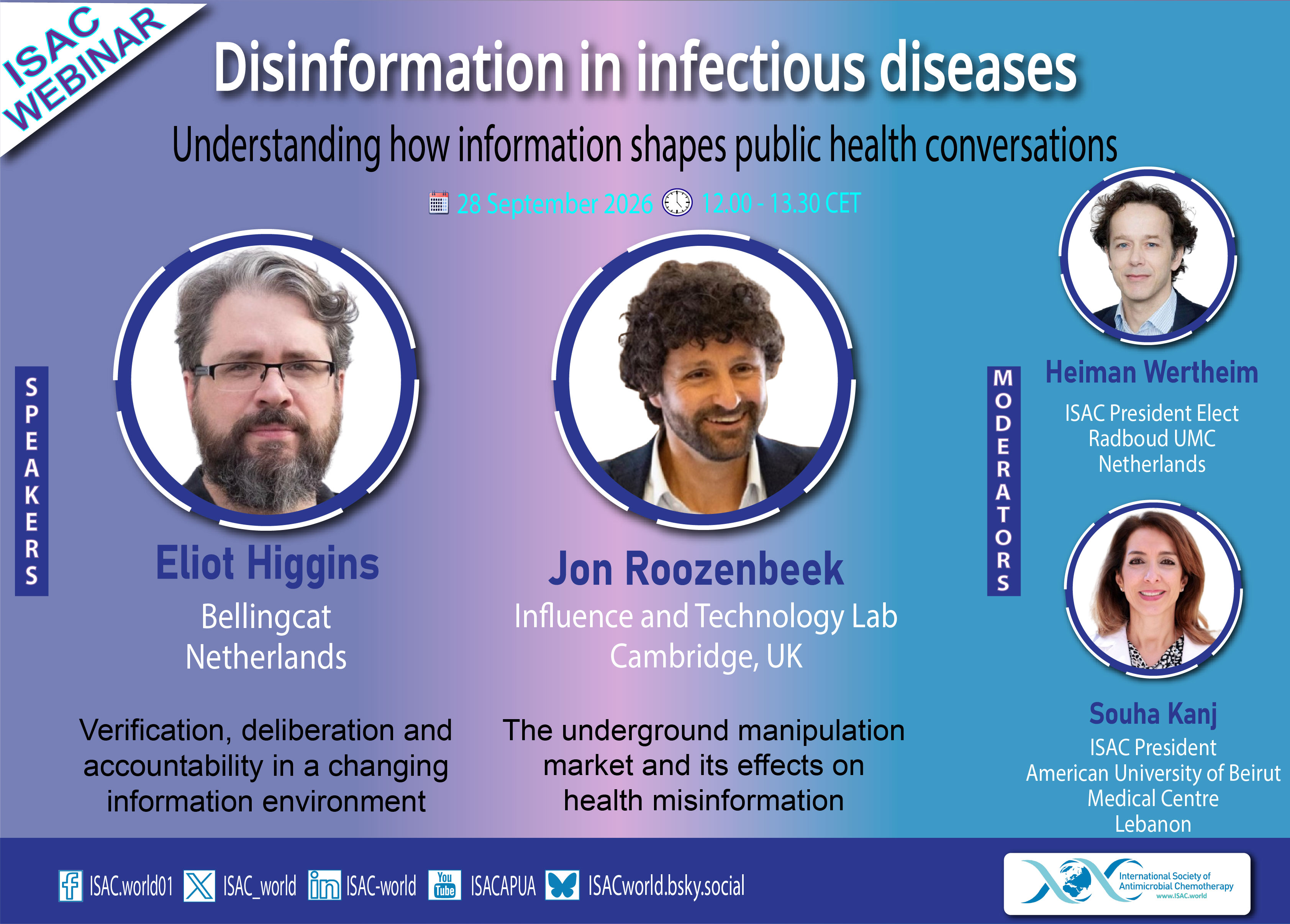
Disinformation can spread faster than any pathogen — and has a negative impact on infectious disease control. ISAC is hosting a webinar with leaders from Bellingcat and Influence Technology Lab, Cambridge, who are at the forefront of understanding how false narratives form, travel and influence public behaviour.
Bellingcat brings world leading expertise in open source investigation: digital forensics, geolocation, network mapping and transparent evidence based analysis. Their work has exposed coordinated disinformation campaigns across global crises.
The Influence Technology Lab specialises in how beliefs form online. Their research explores misbelief formation, digital persuasion and influence technologies.
This webinar is set to deliver a unique and insightful discussion, led by a panel of recognised experts. Join this timely, evidence driven conversation on disinformation and infectious diseases.
|
Programme
-
Verification, democracy and accountability in a changing information environment
Eliot Higgins (Bellingcat, Netherlands)
-
The underground manipulation market and its effects on health misinformation
Jon Roozenbeek (Influence and Technology Lab (ITLab), UK)
Moderators
Heiman Wertheim (ISAC President-Elect) / Souha Kanj (ISAC President)
Speaker bios
Eliot Higgins, founder of Bellingcat and author of We Are Bellingcat, will speak on the VDA Framework, his analytical model for diagnosing democratic health through the conditions of verification, deliberation, and accountability. Drawing on cases ranging from open-source investigation to the contemporary information environment, he will set out how democracies move between substantial, performative, and simulated forms of these functions, and what the framework implies for protecting and rebuilding democratic life.
Jon Roozenbeek is an Associate Professor of Psychology and Director of the Influence and Technology Lab (ITLab), which sits between Cambridge's Department of Psychology and the Department of Communication Science at the Free University of Amsterdam. His research focuses on (mis)belief formation, intergroup conflict (particularly in Russia and Ukraine), polarisation, underground manipulation markets, and the use and misuse of modern communication technologies. Jon has (co-)authored over 80 peer-reviewed publications and two books with Cambridge University Press: The Psychology of Misinformation (with Sander van der Linden) and Propaganda and Ideology in the Russian-Ukrainian War.
|


