

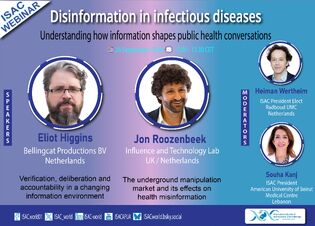


Souha Kanj
ISAC President
Souha Kanj is Professor of Medicine at the American University of Beirut, Faculty of Medicine, Lebanon where she previously led the Division of Infectious Diseases and now chairs the Infection Control Program. She is a Consultant Professor at Duke University, where she trained in Internal Medicine and Infectious Diseases. Author of over 320 publications, she advises the WHO on antimicrobial resistance, infection control, and fungal infections. She serves on editorial boards including Lancet and Mayo Clinic Proceedings. A fellow of major societies, she is President of the Lebanese Society of Infectious Diseases and Clinical Microbiology and of the International Society of Antimicrobial Chemotherapy.
- Peer-Reviewed Journal Articles: Over 320 publications.
- Book Chapters:11 chapters.
- UpToDate Contributions: Author of 8 UpToDate cards.
- Conference Abstracts: 115 abstracts.
- H-index: 67
- Citations: 26,272
| ORCHID ID | |
| ResearchGate | X |
| Google Scholar | Bluesky |

Heiman Wertheim
ISAC President Elect
Heiman Wertheim is a professor in clinical microbiology and heads the clinical microbiology department at Radboud University Medical Center and is chair of the Radboud Center of Infectious Diseases (RCI, www.radboudrci.nl). Heiman is past president of the Netherlands Society of Medical Microbiology (www.nvmm.nl). Until 2015, Heiman was director of the Oxford University Clinical Research Unit (OUCRU, www.oucru.org) in Hanoi, Vietnam. He coordinated laboratory capacity strengthening and conducted research in Southeast Asia. He worked on a broad range of infectious disease issues, varying from zoonoses (e.g. Streptococcus suis, avian influenza) to hospital acquired infections. One of his main interests is antibiotic resistance in both resource rich and resource constrained settings and does this through a multidisciplinary approach: health systems, policy development, behavior, surveillance, prevention, genomics, and clinical trials. He supervised activities for the Global Antibiotic Resistance Partnership (GARP) in Vietnam, which did a situation analysis on antibiotic use and resistance. He received funding to set up a national AMR reference laboratory and to improve the governance structure of AMR in Vietnam. He demonstrated that C-reactive protein point of care testing can bring down antibiotic use safely in primary health stations in Vietnam. Heiman is the PI of the ABACUS project that studies in 3 Asian countries and 3 African countries community antibiotic use. ABACUS project studies also how the appearance of antibiotics influences use. In the Netherlands he is active in the Gelderland Antibiotica Resistentie en Infectiepreventie Netwerk (GAIN) and member of the National Health Council (Gezondheidsraad). He is member of WHO STAG-AMR. For WHO he is consultant in Ukraine since 2024.
Google scholar
LinkedIn

Anuradha Chowdhary
ISAC Secretary General
Prof. Anuradha Chowdhary is a Professor of Medical Mycology at the Vallabhbhai Patel Chest Institute, University of Delhi, India.
She is currently the Secretary General of ISAC.
Her research focuses on antifungal resistance, molecular typing and epidemiology of emerging pathogenic fungi. Dr Chowdhary’s latest research concerns the understanding of the emergence of multidrug resistant strains of Candida auris. This yeast which has globally emerged as a nosocomial pathogen is a serious therapeutic challenge and similar geographical clonal strains of C. auris are emerging in other countries. Her research has additionally yielded important insights into the ecological niches of Cryptococcus and the mechanism and spread of multi azole resistant Aspergillus fumigatus.
Prof. Chowdhary has over 200 publications in peer-reviewed international and national journals and is a Fellow of several prestigious organisations including being a member of the ESCMID Global Scientific Programme Committee.

David Jenkins
ISAC Treasurer
Dr David Jenkins is a consultant medical microbiologist at University Hospitals of Leicester NHS Trust, an 1800- bed organisation in central England, where he is the lead doctor for antimicrobial stewardship and infection prevention. He has an interest in the social, economic and political determinants of infection and antimicrobial resistance both in his local community and globally. He was the president of the British Society for Antimicrobial Chemotherapy between 2021 and 2024 during which time he established the BSAC Global Antimicrobial Stewardship Accreditation Scheme, a quality improvement tool to drive up organisational standards of antimicrobial prescribing.

Geoff Coombs
Immediate Past President
Professor Geoffrey Coombs is the Chair of Public Health at Murdoch University in Western Australia. His areas of research are:
- The molecular evolution of Staphylococcus aureus and Enterococcus faecium
- Molecular epidemiology of Neisseria gonorrhoeae
- Antimicrobial resistance surveillance
He has co-authored over 270 peer-reviewed scientific papers resulting in 13,700 citations. With an h-index of 57, in 2024 he was ranked by ScholarGPS in the top 0.5% of all scholars worldwide.
Professor Coombs is the Past-President for the Australian Society for Antimicrobials, Chair for the Australian Group for Antimicrobial Resistance, and Principal Examiner for the Royal College of Pathologists of Australasia Faculty of Science: Microbiology.
https://researchportal.murdoch.edu.au/esploro/profile/geoffrey_coombs/overview

Michael David
Executive Committee, Ordinary Member
Dr Michael David, MD, PhD, MS, infectious diseases physician, is the director of the Skin and Soft Tissue Clinic at the University of Pennsylvania in Philadelphia, Pennsylvania where he is an Associate Professor of Medicine and Epidemiology. An author of more than 115 peer-reviewed publications, he has focused his research for more than twenty years on the epidemiology, treatment and prevention of Staphylococcus aureus infections. He is studying the evolution of S. aureus colonization on the human body and also its spread in hospitals. The goal of these studies is to define the intrahost evolutionary trajectory of S. aureus that predicts persistence or loss of colonization, risk of person-to-person transmission, and onset of clinically significant infections. Dr David is also interested in the history of infectious diseases.

Sabiha Essack
Ex officio member
Sabiha Essack is the South African Research Chair in Antibiotic Resistance and One Health and Professor in Pharmaceutical Sciences at the University of KwaZulu-Natal in Durban South Africa. She is the co-lead of the Multi-Stakeholder Partnership Platform Action Group on “Stewardship across the Lifecycle of Antimicrobials: a One Health Approach” and member of the WHO Strategic and Technical Advisory Group for AMR. Sabiha serves as the Senior Implementation Research Advisor to the International Centre for Antimicrobial Resistance Solutions, member of the World Economic Forum Global Futures Council for AMR, member of the Combating Antibiotic Resistant Bacteria Biopharmaceutical Accelerator (CARB-X) Advisory Board, and member of the Fleming Fund Expert Advisory Group.

Jose Munita
Ex officio member
My main areas of interest are the clinical and molecular aspects of bacterial antimicrobial resistance. After training at UT Houston, TX, I returned to my home country, Chile, where I established a research group dedicated to the study of multidrug-resistant organisms in Latin America, including understanding their molecular epidemiology, mechanisms of resistance and clinical outcomes of patients infected with resistant bacteria. In addition, we have had several joint projects with the US CDC in order to study the role of bacterial colonization with drug resistant gram-negative pathogens in the dissemination of antimicrobial resistance between the hospital and the community setting.

Jian Li
IJAA Editor in Chief
Professor Jian Li is Editor-in-Chief of the International Journal of Antimicrobial Agents and an elected Fellow of the Australian Academy of Science, the Australian Academy of Health and Medical Sciences, and the American Academy of Microbiology. He heads the Laboratory of Antimicrobial Systems Pharmacology at the Monash Biomedicine Discovery Institute, Melbourne, Australia. His research focuses on antimicrobial pharmacology and drug discovery, highlighted by the development of a novel antimicrobial lipopeptide advanced from concept to clinical trials. Professor Li serves as an invited reviewer for more than 200 international journals and over 35 funding agencies worldwide.

Athanasios Tsakris
JGAR Editor in Chief
Athanasios Tsakris has been a Professor of Microbiology at the Medical School of the University of Athens since 2006. He graduated from the Medical School of Athens and received postgraduate training in clinical microbiology at North Middlesex University Hospital and the Central Public Health Laboratory in London. He obtained his PhD from the London School of Hygiene and Tropical Medicine, University of London. He is a Fellow in medical microbiology and virology of the Royal College of Pathologists, London. He has served as a visiting professor at Beth Israel Deaconess Medical Center in Boston. Dr. Tsakris has been a Scientific Advisory Board Member in the EU for research on antimicrobial resistance, and has acted as an evaluator of research programs in several organizations. He is the Editor-in-Chief of the Journal of Global Antimicrobial Resistance of the ISAC.

Jinxin Zhao
Ex officio member
Dr Jinxin Zhao is a computational biologist and pharmacometrician at the Biomedicine Discovery Institute, Monash University, Australia. His research integrates computational biology and systems pharmacology to develop innovative antimicrobial therapies targeting drug-resistant infections. By combining quantitative modeling with multi-omics and translational pharmacology, Dr Zhao aims to refine therapeutic strategies against critical bacterial pathogens and advance precision approaches in antimicrobial drug development. He is also actively involved in international collaborations and scientific communities promoting model-informed approaches to combat antimicrobial resistance and improve global health outcomes.

David Lye
APSCMI representative
Professor Lye is group director (research), Communicable Disease Agency; senior consultant, Department of Infectious Diseases, National Centre for Infectious Diseases; professor, Lee Kong Chian School of Medicine and Yong Loo Lin School of Medicine; and deputy executive director, Programme for Research in Epidemic Preparedness and Response (PREPARE), Singapore.
His research interests are in COVID-19, dengue and antimicrobial resistance. He has published more than 430 peer-reviewed manuscripts. He was a Clarivate Highly Cited Researcher 2022-2024, and Stanford University Top 2% Scientist 2022-2024.
Professor Lye is President, Society of Infectious Disease (Singapore) and Asia Pacific Society of Clinical Microbiology and Infection.
