


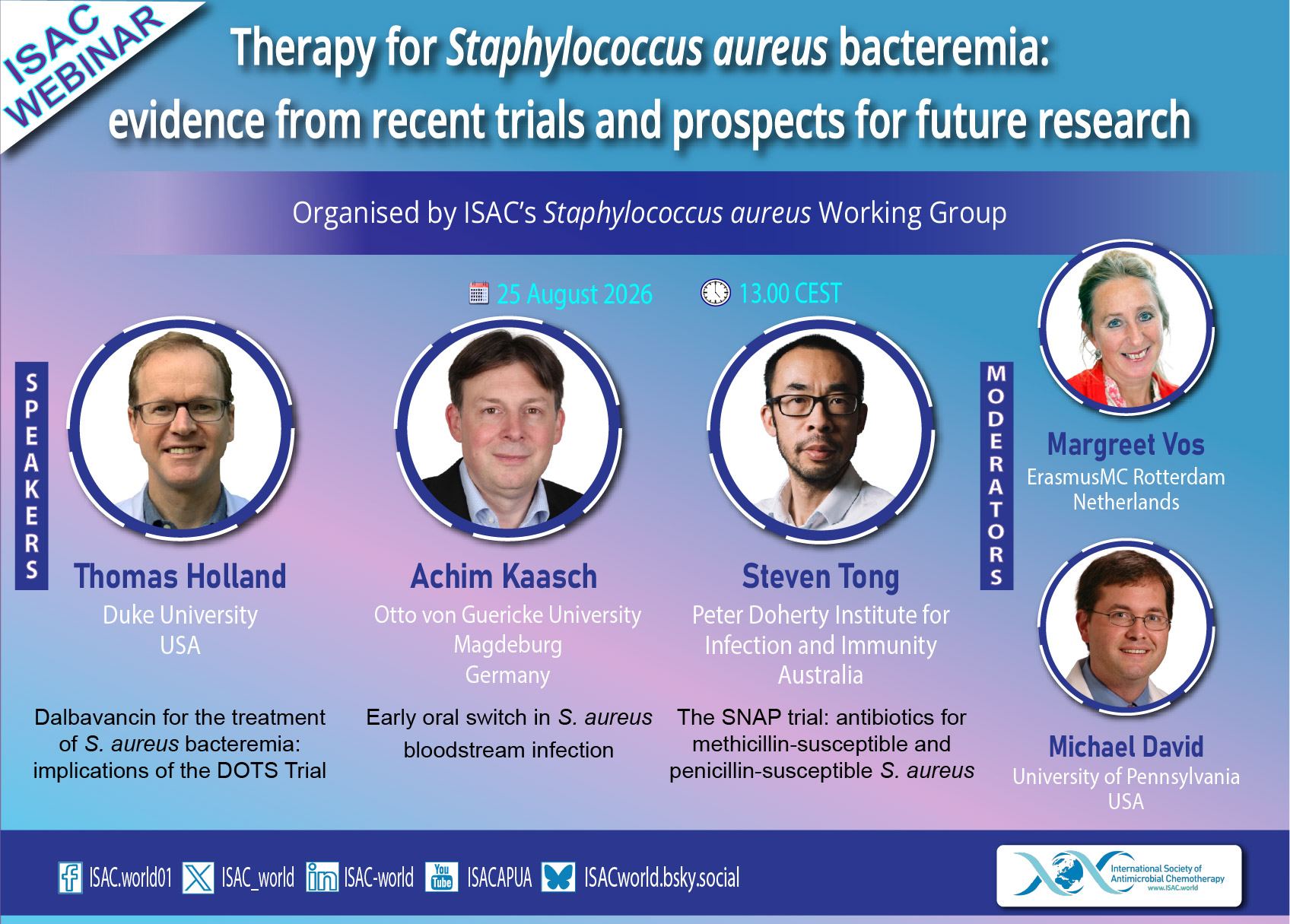
Therapy for Staphylococcus aureus bacteremia: evidence from recent trials and prospects for future research
In this webinar, organised by the ISAC Working Group on Staphylococcus aureus, experts review current practices and ongoing controversies in the management of S. aureus bacteremia — a common, high‑impact infection with a persistent mortality rate of 15-30% even when treated according to guidelines.
The speakers are leading investigators in cutting‑edge clinical trials designed to define optimal antimicrobial therapy for this condition. They present findings from these and other key studies, highlight areas where evidence is evolving, and discuss the critical unanswered questions that continue to shape clinical decision-making. The session also explores future directions and innovative approaches needed to address remaining gaps in the field.
Programme
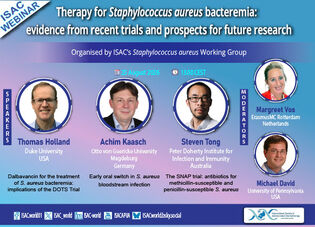
- Dalbavancin for the treatment of S. aureus bacteremia: implications of the DOTS Trial
Prof. Thomas Holland (Duke University) - Early oral switch in S. aureus bloodstream infection
Prof. Achim Kaasch (Otto von Guericke University Magdeburg) - The SNAP trial: antibiotics for methicillin-susceptible and penicillin-susceptible S. aureus
Prof. Steven Tong (Peter Doherty Institute for Infection and Immunity)
Speaker bios
Thomas Holland, MD is a Professor of Medicine, Division of Infectious Diseases, at Duke University. He has expertise in conducting multidisciplinary research in antimicrobial resistance, particularly in the design and conduct of clinical trials in Staphylococcus aureus bacteremia. He led a phase 3 registrational trial of a novel antibiotic (ceftobiprole) for S. aureus bacteremia, which led to its FDA and EMA approval for this indication. He is the chair of the Gram-positive Scientific Committee in the Antibacterial Resistance Leadership Group (arlg.org) and was the PI for its flagship trial testing the safety and efficacy of dalbavancin for S. aureus bacteremia.
Achim Kaasch is Professor of Medical Microbiology at the Otto von Guericke University Magdeburg, Germany. He studied medicine in Würzburg, Germany, and trained at Yale, Johns Hopkins, University of Cologne, and the Charité. He became a professor at the Heinrich-Heine-University Düsseldorf in 2016 and moved to Magdeburg, Germany, in 2019 as Director of the Institute of Medical Microbiology and Hospital Hygiene. His research focuses on diagnosis and treatment of S. aureus bloodstream infection, S. aureus pathogenesis, and infectious disease diagnostics. He conducted the SABATO trial, a landmark study on early oral switch in Staphylococcus aureus bloodstream infections.
Professor Steven Tong is a practising infectious diseases physician at the Royal Melbourne Hospital and Professor of Infectious Diseases, Co-Head of Clinical and Health Services Research at the Doherty Institute, University of Melbourne and Head of Adaptive Platform Trials at the Melbourne Centre for Clinical Trials, University of Melbourne. He leads the Staphylococcus aureus Network Adaptive Platform trial, which is recruiting participants in over 150 hospitals in 14 countries. His research interests include clinical trials for bloodstream infections and acute respiratory tract infections, staphylococcal and streptococcal genomics, and infections affecting Australian First Nations populations
Prof. Margreet C. Vos studied medicine at Erasmus University Rotterdam, Netherlands, graduating cum laude. Since 1995, she has worked at Erasmus MC, where she became Professor of Healthcare‑Related Infections in 2012. For nearly 30 years, she has chaired the hospital’s infection committee, shaping prevention policy. Her research focuses on infection prevention, hospital design, environmental contamination, and transmission epidemiology. She has authored over 250 peer‑reviewed publications and delivered numerous international lectures. Margreet Vos has held leading roles in ESCMID and ISAC and contributed to guideline development, including hospital environmental sampling and infection prevention standards.
Dr Michael David, MD, PhD, MS, infectious diseases physician, is the director of the Skin and Soft Tissue Clinic at the University of Pennsylvania in Philadelphia, Pennsylvania where he is an Associate Professor of Medicine and Epidemiology. An author of more than 115 peer-reviewed publications, he has focused his research for more than twenty years on the epidemiology, treatment and prevention of Staphylococcus aureus infections. He is studying the evolution of S. aureus colonization on the human body and also its spread in hospitals. The goal of these studies is to define the intrahost evolutionary trajectory of S. aureus that predicts persistence or loss of colonization, risk of person-to-person transmission, and onset of clinically significant infections. Dr David is also interested in the history of infectious diseases.
