


Disinformation in infectious diseases
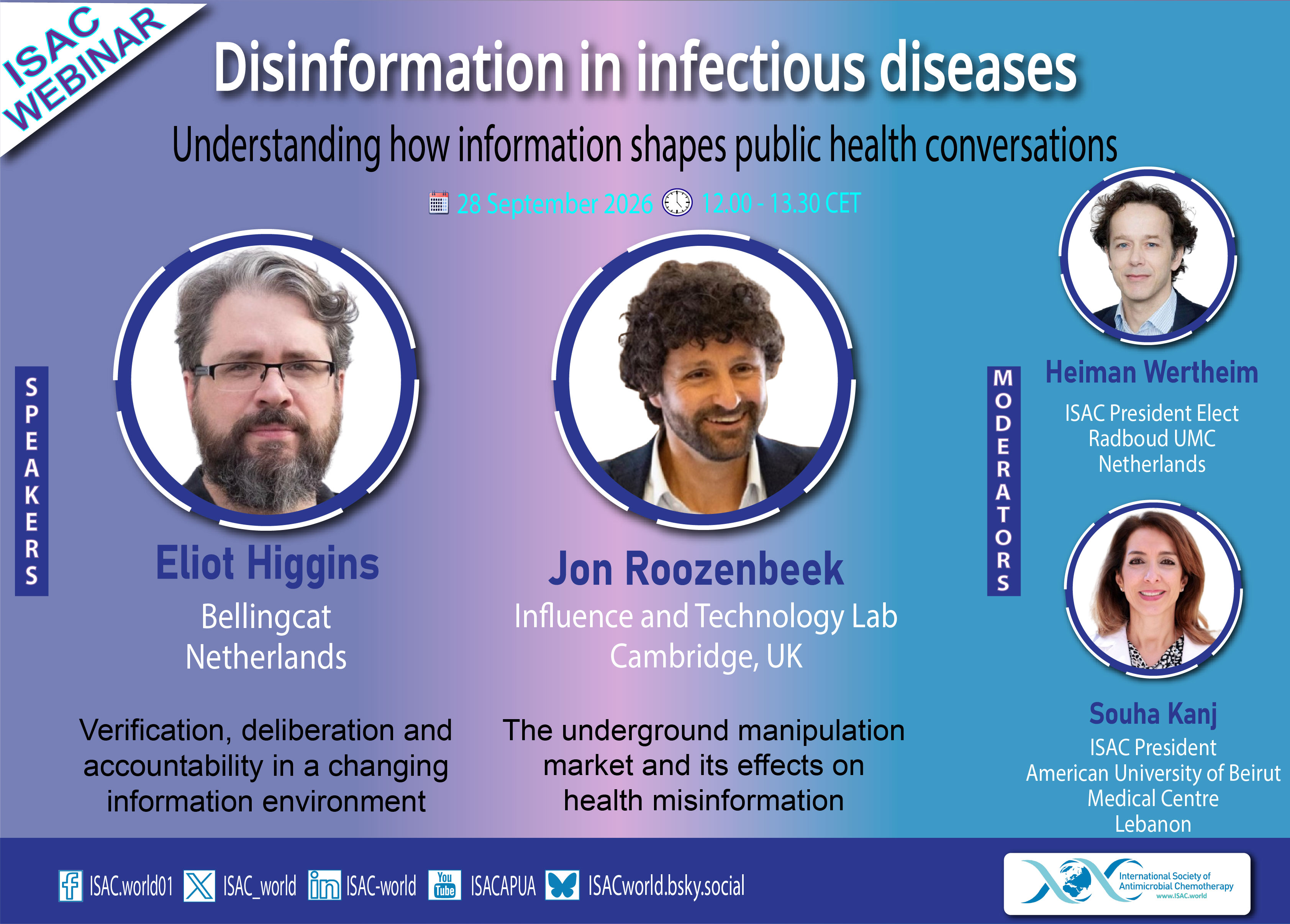
28 September @ 12.00 - 13.30 CEST
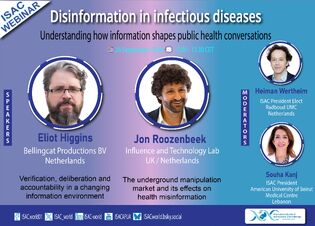
Disinformation can spread faster than any pathogen — and has a negative impact on infectious disease control. ISAC is hosting a webinar with leaders from Bellingcat and Influence Technology Lab, Cambridge, who are at the forefront of understanding how false narratives form, travel and influence public behaviour.
Bellingcat brings world leading expertise in open source investigation: digital forensics, geolocation, network mapping and transparent evidence based analysis. Their work has exposed coordinated disinformation campaigns across global crises.
The Influence Technology Lab specialises in how beliefs form online. Their research explores misbelief formation, digital persuasion and influence technologies.
This webinar is set to deliver a unique and insightful discussion, led by a panel of recognised experts. Join this timely, evidence driven conversation on disinformation and infectious diseases.

Speaker bios
Eliot Higgins
Talk: Verification, democracy and accountability in a changing information environment
Eliot Higgins, founder of Bellingcat and author of We Are Bellingcat, will speak on the VDA Framework, his analytical model for diagnosing democratic health through the conditions of verification, deliberation, and accountability. Drawing on cases ranging from open-source investigation to the contemporary information environment, he will set out how democracies move between substantial, performative, and simulated forms of these functions, and what the framework implies for protecting and rebuilding democratic life.
Jon Roozenbeek
Talk: The underground manipulation market and its effects on health misinformation
Jon Roozenbeek is an Associate Professor of Psychology and Director of the Influence and Technology Lab (ITLab), which sits between Cambridge's Department of Psychology and the Department of Communication Science at the Free University of Amsterdam. His research focuses on (mis)belief formation, intergroup conflict (particularly in Russia and Ukraine), polarisation, underground manipulation markets, and the use and misuse of modern communication technologies. Jon has (co-)authored over 80 peer-reviewed publications and two books with Cambridge University Press: The Psychology of Misinformation (with Sander van der Linden) and Propaganda and Ideology in the Russian-Ukrainian War.
Moderators
Heiman Wertheim, ISAC President Elect
Heiman Wertheim is a professor in clinical microbiology and heads the clinical microbiology department at Radboud University Medical Center and is chair of the Radboud Center of Infectious Diseases (RCI, www.radboudrci.nl). Heiman is past president of the Netherlands Society of Medical Microbiology (www.nvmm.nl). Until 2015, Heiman was director of the Oxford University Clinical Research Unit (OUCRU, www.oucru.org) in Hanoi, Vietnam. He coordinated laboratory capacity strengthening and conducted research in Southeast Asia. He worked on a broad range of infectious disease issues, varying from zoonoses (e.g. Streptococcus suis, avian influenza) to hospital acquired infections. One of his main interests is antibiotic resistance in both resource rich and resource constrained settings and does this through a multidisciplinary approach: health systems, policy development, behavior, surveillance, prevention, genomics, and clinical trials. He supervised activities for the Global Antibiotic Resistance Partnership (GARP) in Vietnam, which did a situation analysis on antibiotic use and resistance. He received funding to set up a national AMR reference laboratory and to improve the governance structure of AMR in Vietnam. He demonstrated that C-reactive protein point of care testing can bring down antibiotic use safely in primary health stations in Vietnam. Heiman is the PI of the ABACUS project that studies in 3 Asian countries and 3 African countries community antibiotic use. ABACUS project studies also how the appearance of antibiotics influences use. In the Netherlands he is active in the Gelderland Antibiotica Resistentie en Infectiepreventie Netwerk (GAIN) and member of the National Health Council (Gezondheidsraad). He is member of WHO STAG-AMR. For WHO he is consultant in Ukraine since 2024.
Prof. Souha Kanj, ISAC President
Souha Kanj is Professor of Medicine at the American University of Beirut, Faculty of Medicine, Lebanon where she previously led the Division of Infectious Diseases and now chairs the Infection Control Program. She is a Consultant Professor at Duke University, where she trained in Internal Medicine and Infectious Diseases. Author of over 320 publications, she advises the WHO on antimicrobial resistance, infection control, and fungal infections. She serves on editorial boards including Lancet and Mayo Clinic Proceedings. A fellow of major societies, she is President of the Lebanese Society of Infectious Diseases and Clinical Microbiology and of the International Society of Antimicrobial Chemotherapy.
