


Emerging antimicrobial therapies for MDR bacterial infections
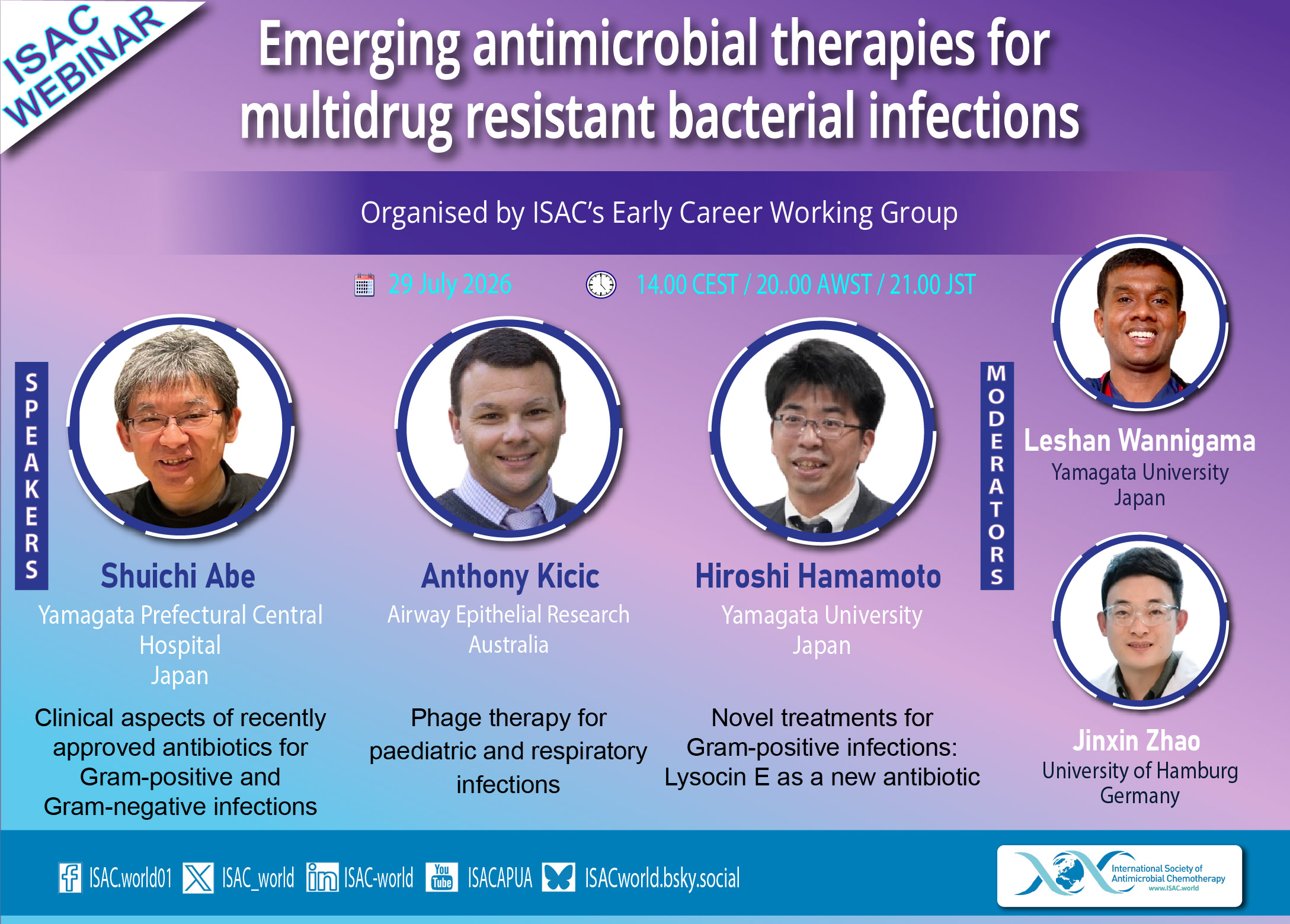
29 July 14.00 CEST / 20..00 AWST / 21.00 JST
Multidrug‑resistant bacterial infections continue to pose a serious global health threat, driving treatment failures, limiting therapeutic options, and increasing clinical burden across both hospital and community settings. As resistance rises, the need for innovative antimicrobial strategies has never been more urgent.
This webinar brings together leading experts from Japan and Australia to explore recent advances in antimicrobial therapy from clinical, translational, and discovery perspectives. The session will offer an integrated view of how newly approved antibiotics, bacteriophage therapy, and emerging antibacterial agents may shape the future management of multidrug‑resistant infections.
Objectives
This webinar will:
Provide an update on recently approved antibiotics for Gram‑positive and Gram‑negative bacterial infections.
Examine the clinical and translational potential of phage therapy, with particular focus on paediatric and respiratory infections.
Highlight novel therapeutic approaches for Gram‑positive pathogens, including Lysocin E as a promising emerging antibiotic candidate.
Facilitate discussion among clinicians, microbiologists, pharmacologists, infectious disease researchers, and antimicrobial resistance specialists on future directions in antimicrobial therapy.
Programme
- Clinical aspects of recently approved antibiotics for Gram-positive and Gram-negative infections
Speaker: Prof. Dr Shuichi Abe - Phage therapy for paediatric and respiratory infections
Speaker: Assoc. Prof. Anthony Kicic - Novel treatments for Gram positive infections: Lysocin E as a new antibiotic
Speaker: Prof. Hiroshi Hamamoto

Speakers
Professor Shuichi Abe is a clinician‑scientist in Infectious Diseases and Director and Co‑Principal Investigator at Yamagata Prefectural Central Hospital, Japan. He also works with the Pathogen Hunter’s Research Team, a Japan–Thailand collaboration focused on accelerating infectious disease discovery and response.
He specialises in respiratory infections, multidrug‑resistant bacterial infections, hospital epidemiology, antimicrobial stewardship, and infection prevention and control, with extensive experience managing complex cases across community and tertiary‑care settings.
Professor Abe’s research spans clinical infectious diseases, epidemiological surveillance, and antimicrobial resistance, with a strong focus on translating clinical evidence into improved patient care and developing strategies to address severe infections caused by multidrug‑resistant pathogens.
Associate Professor Anthony Kicic is Head of Airway Epithelial Research and a Stan Perron Charitable Foundation Research Fellow, and also holds a Western Australian Cystic Fibrosis Research Collaborative Program Fellowship. His work centres on airway epithelial biology, chronic respiratory diseases, cystic fibrosis, and innovative therapies for respiratory infections.
He leads the Western Australian arm of the Phage Australia Project, a national initiative advancing bacteriophage therapy as a precision treatment for multidrug‑resistant bacterial infections—particularly those affecting patients with chronic respiratory diseases such as cystic fibrosis.
Associate Professor Kicic’s team has identified and characterised more than 2,500 bacteriophages active against clinically important respiratory pathogens. Through translational research integrating microbiology, airway biology, and precision medicine, his group aims to move phage therapy toward routine clinical use for difficult‑to‑treat infections.
Professor Hiroshi Hamamoto is Professor of Infectious Diseases at the Department of Infectious Diseases, Faculty of Medicine, Yamagata University, Japan. His research focuses on the discovery and development of novel antimicrobial agents effective against multidrug-resistant bacterial pathogens and on elucidating the molecular mechanisms underlying bacterial and fungal pathogenicity.
Professor Hamamoto’s research integrates multidisciplinary approaches, including genomics, natural products chemistry, analytical chemistry, pharmacokinetics, toxicology, and chemical biology. These complementary methodologies support the identification of new therapeutic targets, the development of next-generation antimicrobial compounds, and the translation of fundamental discoveries into clinically relevant applications.
A/Prof. Leshan Wannigama, MD, PhD, is an Assistant Professor and Infectious Diseases Physician at Yamagata University and Yamagata University Hospital. He also leads the Pathogen Hunters Collaborative as Principal Investigator, with research focused on infectious disease diagnostics, surveillance, and novel therapeutic approaches.
Dr Jinxin Zhao is a Humboldt Research Fellow at the University of Hamburg and Bioinformatics and Computational Biology Team Lead at Monash University. He specialises in AI, bioinformatics, microbial genomics, single-cell sequencing, and mathematical modelling, developing computational approaches to understand antimicrobial resistance, bacterial evolution, and host–pathogen interactions. His work bridges data science and microbiology to support next-generation infectious disease research.
