


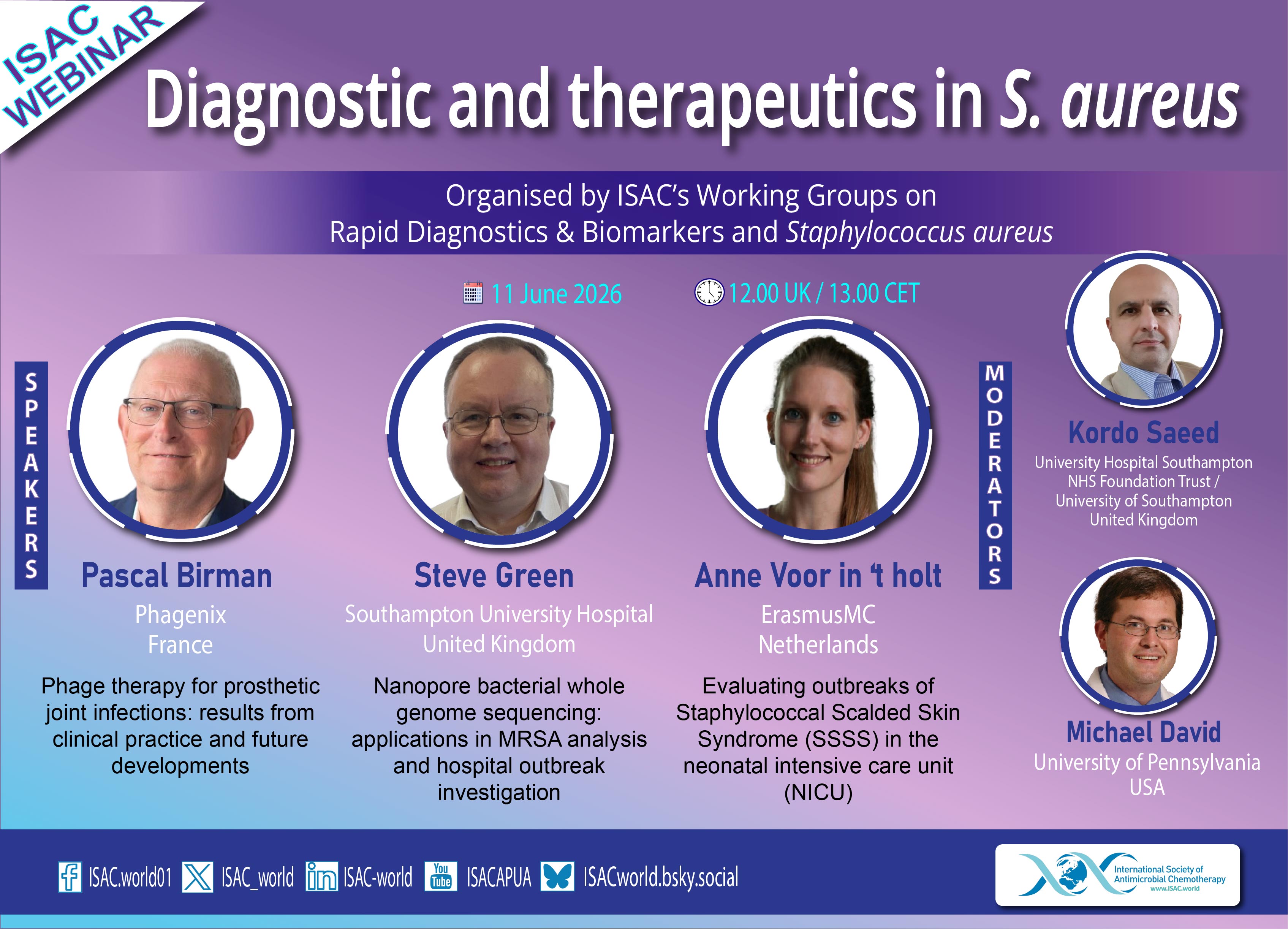
Organised by the ISAC Working Groups on
Rapid Diagnostics and Biomarkers / S. aureus
The webinar brought together three expert perspectives on the evolving landscape of Staphylococcus aureus diagnostics and therapeutics.
Dr Pascal Birman opened the scientific programme with an overview of Phagenix’s development of GMP grade bacteriophages for severe S. aureus prosthetic joint infections. He highlighted their biofilm targeting properties, synergy with antibiotics, and encouraging compassionate use outcomes showing around 80% non relapse at three months. He also outlined the new French regulatory pathway enabling structured compassionate access and introduced the forthcoming GLORIA Phase 2 trial, designed to generate robust evidence for intra articular phage therapy in PGI.
Dr Steve Green followed with a session on the role of nanopore whole genome sequencing in MRSA analysis and outbreak investigation. He demonstrated how real time sequencing enables rapid strain typing and transmission mapping, offering faster and more actionable insights than traditional laboratory methods. His talk illustrated how portable sequencing platforms can be integrated into routine workflows to strengthen infection control responses during suspected hospital outbreaks.
The final presentation, delivered by Dr Anne Voor in ’t Holt, focused on outbreak investigations of Staphylococcal Scalded Skin Syndrome (SSSS) in neonatal intensive care units. She described the vulnerability of premature infants to toxin producing S. aureus strains and emphasised the importance of rapid diagnosis and coordinated infection control measures. She described the establishment of a multidisciplinary SSSS expert team to answer questions about, for example, if healthcare workers should be screened. Questions which did not include medical or microbiology and infection prevention alone but also included ethical considerations and occupational health issues. Her work underscored the need for swift, multidisciplinary action to prevent future outbreaks in high risk neonatal settings.
Programme
- Phage therapy for prosthetic joint infections: results from clinical practice and future developments
Pascal Birman, Phagenix - Nanopore bacterial whole genome sequencing: applications in MRSA analysis and hospital outbreak investigation
Dr Steve Green, Southampton Univeritsy Hospital, UK - Evaluating outbreaks of Staphylococcal Scalded Skin Syndrome (SSSS) in the neonatal intensive care unit (NICU)
Dr Anne Voor in ‘t holt, ErasmusMC, Netherlands
Moderators:
Prof. Kordo Saeed, Chair of ISAC's Rapid Diagnostics & Biomarkers Working Group, University Hospital Southampton NHS Foundation Trust / University of Southampton, United Kingdom
Dr Michael David, Secretary General of ISAC's S. aureus Working Group, University of Pennsylvania, Philadelphia, Pennsylvania, USA
Speaker bios
Pascal Birman MD, has 30 years of experience in medical research and pharmaceutical development, particularly in endocrinology and metabolic diseases. After a career as a physician at the AP-HP (1981-1990), he joined the Servier Group as Head of International Projects, and then held the executive positions of Director of Therapeutic Research and Clinical Operations Director for Europe and Asia. In 2004, Dr. Birman joined the pharmaceutical company Ipsen where he worked for 13 years in several key positions until becoming Vice President of Global Clinical Development Programs.
Dr Steve Green is a Clinical Scientist and NHS microbiologist at University Hospital Southampton (UHS). With over 30 years of experience in molecular microbiology, his scientific interests are in the epidemiology and pathogenesis of healthcare-acquired bacterial infections including S.aureus. He is the lead for applying bacterial typing to outbreak investigation for the trust infection prevention team and previously headed the Public Health England C.difficile Ribotyping Network regional service for the South East.
He is a member of the Wessex Infection Network for Genomics (WING) and the scientific lead for an R&D group that is implementing nanopore-based metagenomic sequencing into microbial diagnostics as part of the NHS Genomic Network of Excellence: Severe Presentation of Infectious Disease.
As a member of the Association for Laboratory Medicine he has been secretary and chair of their Microbiology Professional Committee. He is currently chair of the UHS Microbiology Laboratory Development Group.
Dr Anne Voor in ’t holt is a clinical epidemiologist at Erasmus MC University Medical Center in Rotterdam. She obtained her PhD in 2018 on in-hospital transmission of healthcare-associated pathogens and is currently an assistant professor in infection prevention and control research. Her work focuses on microbial-safe healthcare environments, pathogen transmission dynamics, smart surveillance strategies, and outbreak management.
