

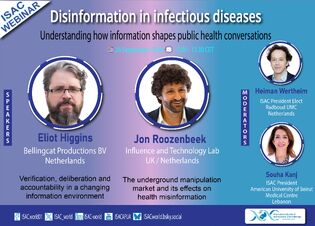


The Alliance for the Prudent Use of Antibiotics (APUA) is delighted to invite you to its next free webinar.
Superinfection of viral respiratory infection has been one of the hottest topics during the first waves of COVID-19: although it was rapidly demonstrated that coinfections were rare during the first days, fungal or bacterial superinfections was a major cause of death for intensive care unit patients on various immunosuppressive treatments (dexamethasone, IL6-inhibitors, etc.), who required prolonged mechanical ventilation. More recently, the burden of Group A streptococci superinfections have dramatically increased, in children and in adults, for reasons that still remain unclear.
Join this free webinar, organised by the Alliance for the Prudent Use of Antibiotics (APUA), to hear from three worldwide experts in the field of superinfections who will share with us the main features of these hot topics.

Speakers
Prof. Nina van Sorge is full Professor and Director of the Netherlands Reference Laboratory for Bacterial Meningitis (NRLBM) at Amsterdam UMC, The Netherlands. Her lab combines fundamental and molecular epidemiological research to improve existing and identify new strategies to prevent and treat bacterial infections. Her experimental work specifically focuses on the human pathogens Staphylococcus aureus and Streptococcus pyogenes (Strep A), for which she is co-inventor on a patent on Strep A vaccine development. In addition, she coordinates and leads the activities in the NRLBM, which performs the national bacteriological surveillance for invasive bacterial infections, including invasive group A streptococcal infections.
Prof. Anuradha Chowdhary is a Professor of Medical Mycology in the Department of Medical Mycology at Vallabhbhai Patel Chest Institute, University of Delhi, India. Prof. Chowdhary is a member of the ISAC Executive Committee. Her research focus on antifungal resistance, molecular typing and epidemiology of emerging pathogenic fungi. Prof. Chowdhary’s latest research concerns the understanding of the emergence of multidrug resistant strains of Candida auris. This yeast which has globally emerged as a nosocomial pathogen is a serious therapeutic challenge and similar geographical clonal strains of C. auris are emerging in other countries. Her research has additionally yielded important insights into the ecological niches of Cryptococcus and the mechanism and spread of multi azole resistant Aspergillus fumigatus.
Prof. Alex Soriano is a Consultant of Infectious Diseases in the Infectious Diseases Department of the Clinical and Provincial Hospital of Barcelona, Spain, since 2001. He studied medicine at the University of Barcelona from where he also received his Ph.D. in Medicine. His main research interest is in severe infections caused by Gram-positive and Gram-negative bacteria, as well as the diagnosis and treatment of foreign-body infections, with a particular interest in prosthetic joint infections. In recent years, Alex has studied the effectiveness of combination therapy versus monotherapy, using a third-generation cephalosporin in bacteraemic Pneumococcal pneumonia. He has suggested that therapy with a cephalosporin plus a macrolide or a fluoroquinolone is associated with a lower mortality rate compared with β-lactams. Alex has also been involved in utilising new antibiotics against Gram-positive bacteria and in the use of antibiotics against erythromycin-susceptible and -resistant Streptococcus pneumoniae. He has authored several book chapters and over 300 peer-reviewed publications and is currently the Vice President of the European Bone and Joint Infection Society (EBJIS) and Co-editor in Chief of Infectious Diseases and Therapy.
Prof. Souha Kanj is a tenured Professor of Medicine at the American University of Beirut Medical Center, Lebanon, and Consulting Professor at the Duke University Medical Center, Durham, North Carolina, USA. She is currently President-Elect of ISAC, Head of the Division of Infectious Diseases, Chair of the Infection Control and Prevention Program, Co- Chair of the Antimicrobial Stewardship Program and Associate Dean for Global Affairs at the American University of Beirut Medical Center. Prof. Kanj has published more than 230 papers in national and international journals such as Mycoses, Infection, Lancet Infectious Diseases and the Journal of the American Medical Association (JAMA). She has contributed greatly to the work of the World Health Organization (WHO) in various programs, such as the R&D Blueprint Annual Review of Priority Diseases, the Global Infection Prevention and Control Network, and the WHO Priority Pathogens List Project for Antimicrobial Resistant Bacteria.
