


Membership
Current Officers


All Members
| Peter Appelbaum (USA) |
| Valerie Baede (The Netherlands) |
| Abhijit Bal (UK) |
| Marc Bonten (The Netherlands) |
| Marine Butin (France) |
| Elena Carrara (Italy) |
| Roberta Cauda (Italy) |
| Geoff Coombs (Australia) |
| Ralph Corey (USA) |
| Mette Damkjær Bartels (Denmark) |
| Stephanie Dancer (UK) |
| Matthew Dryden (UK) |
| Johnathan Edgeworth (UK) |
| Andrea Endimiani (Switzerland) |
| Silvano Esposito (Italy) |
| Laurent Frederic (France) |
| Javier Garau (Spain) |
| Evangelos Giamarellos-Bourboulis (Greece) |
| Efthymia Giannitsioti (Greece) |
| Tom Gottlieb (Australia) |
| Hajo Grundmann (The Netherlands) |
| Francesco Guidol (Spain) |
| Stephan Harbarth (Switzerland) |
| Peter Hawkey (UK) |
| Helen Heffernan (New Zealand) |
| Matthew Holden (UK) |
| Benjamin Howden (Australia) |
| Po-Ren Hsueh (Taiwan) |
| Trond Jacobsen (Norway) |
| Vincent Jarlier (France) |
| Adam Ahmed Kikerbo (Nigeria) |
| Angela Kearns (UK) |
| Jesper Larsen (Denmark) |
| Moysis Lelekis (Greece) |
| Daniel Lew (Switzerland) |
| Jodi Lindsay (UK) |
| Fiona MacKenzie (UK) |
| Teresita Mazzei (Italy) |
| José Melo Cristino (Portugal) |
| John Merlino (Australia) |
| Marina Morgan (UK) |
| Christoph Naber (Germany) |
| Andrea Novelli (Italy) |
| Annalisa Pantosti (Italy) |
| Federico Pea (Italy) |
| Sharon Peacock (UK) |
| Georg Peters (Germany) |
| Francesco Scaglione (Italy) |
| Kordo Saeed (UK) |
| Atef Shibl (Saudi Arabia) |
| Bibi Slingerland (Netherlands) |
| Alex Soriano (Spain) |
| Marc Struelens (Belgium) |
| Evalina Tacconelli (Italy) |
| Paul Tambyah (Singapore) |
| Pierre Tattevin (France) |
| Fred Tenover (USA) |
| Serhat Unal (Turkey) |
| Alex Van Belkum (The Netherlands) |
| Anne van't Holt (The Netherlands) |
| Henri A Verbrugh (The Netherlands) |
| Andreas Voss (The Netherlands) |
| Henrik Westh (Denmark) |
| Wolfgang Witte (Germany) |
How to Join
ISAC Working Groups are open to new members with a strong interest and relevant experience in the given field. To join an ISAC Working Group, please contact Fee Johnstone, ISAC Executive Officer secretariat@isac.world with your name and a brief C.V. We welcome new members!
Aims and Objectives
Staphylococcus aureus is a among the most common pathogens causing infections in human populations worldwide. While the majority of clinically significant S. aureus infections are of the skin and soft tissues, the species is also a common cause of osteomyelitis, bacteremia, device infections, surgical site infections, and hospital-acquired pneumonia. As there is no available vaccine to prevent S. aureus infections, and because S. aureus is a commensal organism, carried by approximately 40% of people as part of the microbiome, prevention of infection is complex. The antimicrobial susceptibilities of S. aureus strains vary greatly, and S. aureus has evolved resistance to all available classes of antimicrobials after their introduction. Methicillin-resistant S. aureus (MRSA) strains, first reported in 1961, are inherently resistant to all conventional beta-lactam drugs. MRSA particularly remains a scourge of health services worldwide, and it continues to evolve, with new superantigen and toxin-bearing strains that have arisen de novo in the community since the 1990s. These so-called community-associated (CA-) MRSA strains are highly transmissible and can cause fatal infections even in previously healthy individuals. Other strains have been commonly found among livestock and wild animals, and these are often termed livestock associated (LA-) MRSA strains.
S. aureus has a unique ability to colonise, evolve, invade human tissues, causing a wide variety of primary and opportunist infections, to survive in the environment, and to spread from person to person, often via healthcare staff, close contacts, or fomites. Genomic studies of S. aureus have demonstrated the great potential genetic diversity of the species and have been used to elucidate mechanisms underlying strain differences in pathogenicity, virulence and antimicrobial resistance.
The Staphylococcus aureus Working Group aims to foster the international exchange of ideas and new research into all aspects of S. aureus with a view to discovering the best control and treatment strategies by implementing the following work plan:
• Organise workshops on S. aureus
• Organise occasional post-graduate educational meetings on S. aureus
• Sponsor webinars on all aspects of S. aureus treatment, prevention and surveillance
• Encourage submission of original research to the International Journal of Antimicrobial Agents and the Journal of Global Antimicrobial Resistance
• Encourage collaborative research on S. aureus
• Prepare and publish consensus statements on important clinical aspects of S. aureus
Webinars
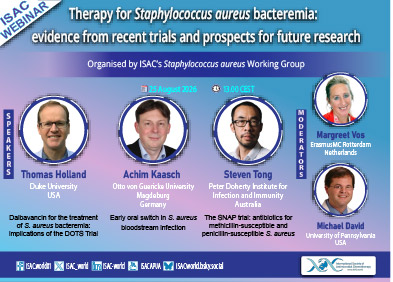
Therapy for Staphylococcus aureus bacteremia: evidence from recent trials and prospects for future research
25 August 2026 13.00 CEST
In this webinar, organised by the ISAC Working Group on Staphylococcus aureus, experts will review current practices and ongoing controversies in the management of S. aureus bacteremia — a common, high‑impact infection with a persistent mortality rate of 15-30% even when treated according to guidelines.
The speakers are leading investigators in cutting‑edge clinical trials designed to define optimal antimicrobial therapy for this condition. They will present findings from these and other key studies, highlight areas where evidence is evolving, and discuss the critical unanswered questions that continue to shape clinical decision-making. The session will also explore future directions and innovative approaches needed to address remaining gaps in the field.
Programme
- Dalbavancin for the treatment of S. aureus bacteremia: implications of the DOTS Trial
Prof. Thomas Holland (Duke University) - Early oral switch in S. aureus bloodstream infection
Prof. Achim Kaasch (Otto von Guericke University Magdeburg) - The SNAP trial: antibiotics for methicillin-susceptible and penicillin-susceptible S. aureus
Prof. Steven Tong (Peter Doherty Institute for Infection and Immunity)

Diagnostic and therapeutics in S. aureus
Organised by the ISAC Working Groups on Rapid Diagnostics and Biomarkers / S. aureus
This webinar explores the rapidly evolving landscape of Staphylococcus aureus diagnostics and therapeutics, bringing together three complementary perspectives that span cutting-edge treatment strategies, real-time genomic technologies, and emerging diagnostic approaches for complex infections.
Programme
Phage therapy for prosthetic joint infections: results from clinical practice and future developments Pascal Birman, Phagenix
Nanopore bacterial whole genome sequencing: applications in MRSA analysis and hospital outbreak investigation Dr Steve Green, Southampton Univeritsy Hospital, UK
Evaluating outbreaks of Staphylococcal Scalded Skin Syndrome (SSSS) in the neonatal intensive care unit (NICU) Dr Anne Voor in ‘t holt, ErasmusMC, Netherlands
Moderators: Prof. Kordo Saeed, Chair of ISAC's Rapid Diagnostics & Biomarkers Working Group, University Hospital Southampton NHS Foundation Trust / University of Southampton, United Kingdom Dr Michael David, Secretary General of ISAC's S. aureus Working Group, University of Pennsylvania, Philadelphia, Pennsylvania, USA
-----------------------------------------------
Antibiotic susceptibility patterns used for epidemiologic surveillance of Staphylococcus aureus
Regional and National MRSA Surveillance Programmes
The first meeting included brief presentations from laboratories in several countries that undertake MRSA surveillance. This was followed by a period of moderated discussion to assess best practices. The goals were to understand the variety of approaches to surveillance worldwide and to develop principles that may underlie future harmonization of surveillance methods.
Presentations / Publications
| MRSA Surveillance Programmes Worldwide: Moving towards a harmonised international approach Valérie O Baede, Michael Z David, Arjana Tambic Andrasevic et al Int J Antimicrob Agents. 2022 Mar;59(3):106538. doi: 10.1016/j.ijantimicag.2022.106538. |
|
| November 2016 | 6th MRSA Working Group Consensus Conference, Palma de Mallorca, Spain |
| May 2014 | 5th MRSA Working Group Consensus Conference, Verona, Italy |
| June 2013 | Symposium for the 28th ICC in Yokohama, Japan |
| May 2013 | 4th MRSA Working Group Consensus Meeting, Sicily |
| November 2012 | Symposium at the 3rd SEEC in Dubrovnik, Croatia |
| May 2012 | 3rd MRSA Working Group Consensus Meeting, Naples |
| November 2011 | Symposium at the 2nd SEEC in Belgrade, Serbia |
| September 2011 | 51st ICAAC Symposium, Washington DC, USA |
| May 2011 | 27th ICC Symposium, Milan, Italy |
| March 2011 | 2nd MRSA Consensus, Florence, Italy |
| September 2010 | Symposium at Asian Congress of Paediatric Infectious Diseases, Taiwan |
| May 2010 | 4th ISC European Conference on Blood Stream Infections, Athens, Greece |
| March 2010 | 1st MRSA Consensus Conference, Rome, Italy |
Future / Ongoing Projects
- Planning / writing consensus papers relevant to the Working Group
- Regular group meetings
- Sending proposals for the 33rd International Congress of Antimicrobial Chemotherapy (ICC)
Last updated: August 21st-2026
