

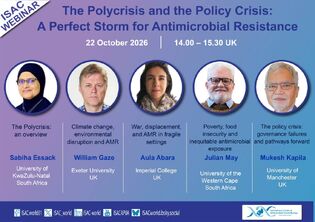

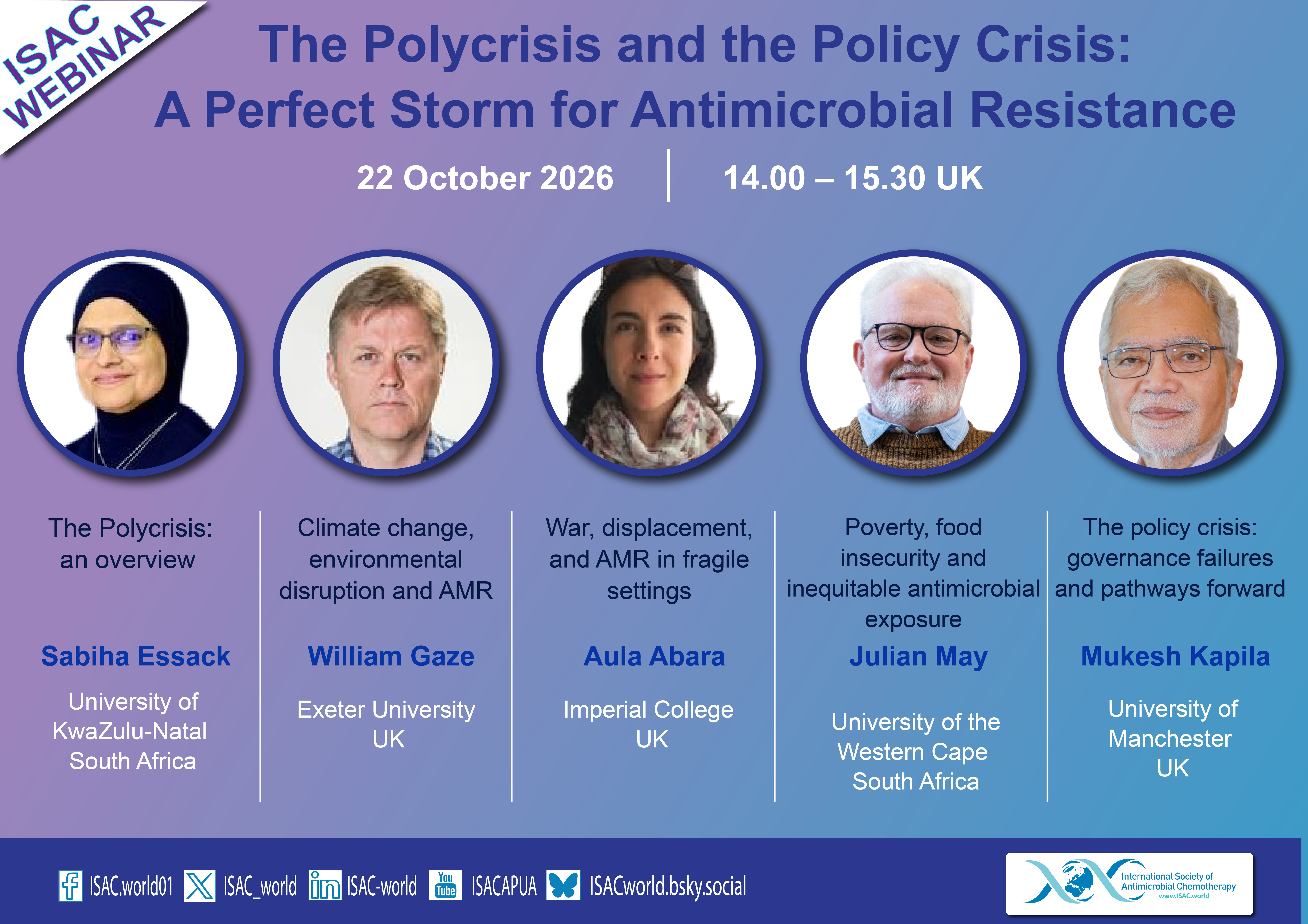
The Polycrisis and the Policy Crisis: A Perfect Storm for Antimicrobial Resistance
22 October at 14.00 - 15.30 UK
Antimicrobial resistance (AMR) is increasingly shaped by interconnected global crises including climate change, armed conflict and displacement, poverty and food insecurity, inequitable access to therapeutics and diagnostics, and misinformation. These overlapping pressures amplify infectious disease burden, antimicrobial exposure, and the spread of resistant pathogens across human, animal, and environmental systems. At the same time, fragmented and weak global governance has limited effective mitigation and response.
Webinar Objectives
• Examine how interconnected global risks are accelerating AMR across One Health systems.
• Explore pathways linking climate change, conflict, poverty, and inequity to infectious disease and antimicrobial use.
• Critically analyse failures and gaps in global governance and policy implementation.
• Identify opportunities for integrated, rights-based, and planetary health approaches to AMR mitigation.

Speaker bios
Prof. Sabiha Essack is the South African Research Chair in Antibiotic Resistance and One Health and Professor in Pharmaceutical Sciences at the University of KwaZulu-Natal in Durban South Africa. She is the co-lead of the Multi-Stakeholder Partnership Platform Action Group on “Stewardship across the Lifecycle of Antimicrobials: a One Health Approach” and member of the WHO Strategic and Technical Advisory Group for AMR. Sabiha serves as the Senior Implementation Research Advisor to the International Centre for Antimicrobial Resistance Solutions, member of the World Economic Forum Global Futures Council for AMR, member of the Combating Antibiotic Resistant Bacteria Biopharmaceutical Accelerator (CARB-X) Advisory Board, and member of the Fleming Fund Expert Advisory Group.
Dr Aula Abbara is a Consultant in Infectious Diseases at Imperial College Healthcare NHS Trust and an Honorary Clinical Senior Lecturer at Imperial College London. She teaches on Imperial’s Global Health BSc and at LSHTM.
She has extensive humanitarian experience across Syria, Greece, Lebanon, the Rohingya crisis and the Ebola response in Sierra Leone, earning both a Women in Global Health Award and the Ebola Medal of Service.
She co‑chairs the Syria Public Health Network, chairs Health Professionals for Global Health, and advises UN ESCWA, WHO and other organisations on refugee and migrant health. Her research focuses on attacks on healthcare, AMR in conflict and refugee health workforce issues.
She received Imperial College’s Emerging Alumni Leaders Award in 2020.
Prof. Mukesh Kapila, CBE is Professor Emeritus of Global Health and Humanitarian Affairs, University of Manchester; and Senior Adviser to the Parliamentary Assembly of the Mediterranean. His extensive career spanning emergency crises, humanitarian and health management and diplomacy has taken him to over 120 countries across all continents including the most complex disasters and wars. He has served in senior positions at the UK Foreign, Commonwealth and Development Office, United Nations, World Health Organization, International Federation of Red Cross and Red Crescent Societies, and advised many multilateral institutions including the World Bank, UN agencies, and NGOs including as member or chair of the boards of several.
Professor Kapila has qualifications in medicine, public health, and development from the Universities of Oxford and London. He is a public and media speaker and writer. His books include ‘Against A Tide Of Evil’ (2013) and ‘No Stranger to Kindness’ (2019). His many awards include a CBE from King Charles III, a Global Citizenship Award, the “I Witness!” award for human rights, and a special resolution of the California State Legislature for “lifetime achievements and meritorious service”.
Prof. Julian May is the Director of the NRF-DSTI Centre of Excellence in Food Security at the University of the Western Cape and holds the UNESCO Chair in Science and Education for Sustainable African Food Systems., During his career he has been involved in impact assessments and poverty diagnostics in twenty countries in Africa, Latin America and the Indian Ocean Islands. He focuses on policy options that address the structural causes of poverty. His current research includes childhood malnutrition, climate change and food system governance.
He has published over 100 academic papers on food security, poverty and inequality in peer reviewed books and academic journals and has edited 7 books. As an applied economist, he has also completed more than 100 research reports for governments, the private sector and civil society organisations, and over 80 science communication publications such as op-eds, policy briefs, and monographs.
He has a long record of community service. He is currently a member of Council of the Academy of Science in South Africa (ASSAf) and chairs the Audit and Risk Committee. He serves on the Council of the University of the Western Cape and served two terms on the South African Statistics Council, chairing the sub-Committee on Population and Social Statistics. From 2008-2012 he served on the Technical Advisory Group of the World Bank’s International Comparison Program, a worldwide statistical initiative to collect comparative price data for national accounting. In 2022, he was appointed to the South African National Planning Commission
Prof. William Gaze is a distinguished Professor of Microbiology at the Department of Public Health and Sport Sciences. His research focuses on the evolution of antimicrobial resistance (AMR) within complex microbial communities found in human, animal, and environmental microbiomes. He also studies the dissemination of AMR at a landscape scale and human exposure and transmission in aquatic environments.
Professor Gaze’s expertise is recognised globally, as evidenced by his numerous invited presentations across Europe, North America, South America, Asia, and Africa over the past few years. He gives particular focus to interactions with stakeholders from government, regulators, and industry through two NERC Knowledge Exchange Fellowships awarded to him in 2019 and 2021. He advises the United Nations, World Health Organisation, UK, and overseas governments on AMR.
Professor Gaze also plays a significant role in academic leadership. He is a member of the University Senate, departmental leadership team, and the GW4 AMR Alliance Steering Committee. He is a co-lead of the Exeter Microbes & Society network of over 300 researchers across all three faculties.
