



ISAC Project Grant Awardees

We are delighted to announce the awardees of the recent ISAC Project Grant initiative.
The decision on which projects to fund was difficult – we received many more applications than we could fund and the competition was strong. But after careful consideration by a panel of experts, three important projects were selected that address research gaps with demonstrable and achievable goals.
The 2021 ISAC Project Grant awardees are:
Margaret Ip (The Chinese University of Hong Kong, Hong Kong)
"Nasal colonization of Methicillin-resistant Staphylococcus aureus and Streptococcus pneumoniae in kindergarten children in Sri Lanka"
Margaret Ip is Professor and Chairman of the Department of Microbiology at the Chinese University of Hong Kong. She is an Honorary Consultant in Clinical Microbiology at the Prince of Wales Hospital, and is an experienced clinical microbiologist passionate in research targeting antimicrobial resistance, especially of clinically important bacterial pathogens including MRSA, Streptococcus pneumoniae, Streptococcus agalactiae (Group B Streptococcus) and other multidrug-resistant organisms (MDROs).
Her interests include applications of new technologies, microbial multiomics and metagenomics in the diagnoses and prevention of infections.
She is a member of ISAC Member Societies, the Hong Kong Society for Microbiology and Infection and British Society of Antimicrobial Chemotherapy.
Ebenezer Foster-Nyarko (London School of Hygiene and Tropical Medicine, UK)
"Genomic surveillance of antimicrobial resistance in clinical Klebsiella pneumoniae isolates from Ghana"
Ebenezer Foster-Nyarko is a Research Fellow in Professor Kathryn Holt's group at the London School of Hygiene and Tropical Medicine, UK. His current research involves undertaking high-quality computational genomics-based research to elucidate the genetic determinants of AMR and virulence in Klebsiella pneumonia and contributing to research aimed at improving phenotype prediction from genotypic data to enhance genomic surveillance AMR and virulence in K. pneumoniae.
His PhD focused on exploring the ecology of Escherichia coli in the vertebrate gut. Previous research experience has included utilising clinical microbiological and molecular techniques to investigate the efficacy of novel and existing vaccines, antimicrobial resistance and colonisation dynamics of respiratory pathogens. For five years, he was involved in invasive bacterial diseases and antimicrobial resistance surveillance in the WHO Regional Co-ordinating Centre headed by Professor Martin Antonio at the Medical Research Council Unit The Gambia (MRCG at LSHTM). Publications and co-authored works are available here.
Ebenezer Foster-Nyarko is a member of ISAC Member Society, the British Society of Antimicrobial Chemotherapy
Abdullah Al Masud (University of New South Wales, Australia)
"Practices of antibiotic consumption and dispensing in the middle and low-income people in Bangladesh: a potential contributor to the emergence of antimicrobial resistance in the community"
Abdullah Al Masud graduated in social anthropology both in the Bachelor and Master of Social Science from Jahangirnagar University, Bangladesh, and accomplished a Master of Public Health degree at the James P. Grant School of Public Health, BRAC University, Bangladesh with the full financial support of the Fogarty Foundation International Fellowship. He has been working as Assistant Scientist at International Centre for Diarrhoeal Disease Research, Bangladesh, an international Center for Health and Population Research since August 2011. He has extensive experience in research and intervention designs and impact evaluation of water, sanitation and hygiene, nutrition and antimicrobial resistance. He has practical experience in implementing public health programmes in Child Health and Mortality Prevention Surveillance (CHAMPS) in Bangladesh. His social science background drives him to think about the contextual socio-cultural and political factors that impact public health.
Recently, he has been offered and accepted a University International Postgraduate Award (UIPA) to pursue a full-time PhD at the School of Population Health, University of New South Wales, Australia. His PhD research topic is Practices of antibiotic consumption and dispensing in the middle and low-income people in Bangladesh: a potential contributor to the emergence of antimicrobial resistance in the community.
Abdullah Al Masud is a member of ISAC Member Society, the Australian Society for Antimicrobials.

AMR / ID Project Grant applications are now closed.
The next round of applications will be invited later in 2022.
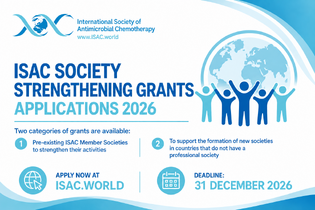
Applicants are required to demonstrate that ISAC funds will be utilised for a clearly defined piece of research, which will have an identifiable outcome on completion of the work. At least one country involved must be a low- to middle- income country.
Research projects should address one of the three following areas:
- What are feasible and effective prevention strategies to prevent transmission of (resistant) pathogens in low resource settings?
- What basic laboratory support does a healthcare system minimally need to tackle infectious diseases?
- How do we improve antimicrobial use worldwide to ensure it is delivered only to those who need it?
Funding
- Applicants can apply for grants between £5,000 - £10,000.
- Recipients will receive 50% of the grant in advance of the project and 50% on completion.
Project criteria
- Projects can last up to 24 months.
- 6-monthly updates are required.
- Funds can be used for staff or materials.
- At least two institutions should be involved in the project of which at least one is from a low- or middle-income country.
Eligibility of applicants
- Principal applicant must be a member of an ISAC Member Society. Visit the website to see the full list of ISAC Member Societies. Any relevant society which is not a member can apply for membership by emailing secretariat@ISAC.world. Once the society’s application has been approved, members can apply for Project Grants.
- The other applicants do not need to be a member of an ISAC Member Society.
- The principal applicant must be the principal investigator on the intended research.
- At least one country involved must be a low- to middle- income country.
Reporting Results
- Awardees will be required to provide a written report within three months of finalising the project.
- Awardees to provide written updates every 6 months on progress (200 words).
- The final report should be a maximum of two pages (Arial, 12) with a 200-500-word summary for the website / ISAC Newsletter / society information page within both IJAA and JGAR.
- Manuscripts which result from the ISAC funded work must be submitted to either IJAA or JGAR in the first instance. A manuscript may only be submitted to an alternative journal if it has been rejected by both IJAA and JGAR. The grant is to be acknowledged in the appropriate section.
Application Process
To apply for a grant, applicants will be required to submit the following:
- An application form.
- Proof of Member Society membership.
- A Curriculum Vitae (one page) of the main applicants.
- Confirmation of the application from the Head of Department and confirmation that the Department has the resources required to undertake the project.
- Please send your completed application form and supporting documents to secretariat@ISAC.world.
Terms and Conditions
- International Society of Antimicrobial Chemotherapy to be acknowledged on all resulting publications and presentations.
- 6-monthly progress reports to be submitted to the ISAC Executive Committee.
- Research funds to be used for the project, as per the budget application only.
ISAC does not support indirect costs to institutions. - Applications / reports to be written in English.
- Only one application per applicant per year.
- Grant applications will be assessed by a panel of independent reviewers / the ISAC Executive Committee, using a standardised scoring system.
Click here to download the application form.
For more information, please contact secretariat@ISAC.world.
 Previous Awardees

PUTERI JUANITA ZAMRI, Hospital Selayang, Malaysia
Optimized Doses of Polymyxins to Improve Outcomes for Non-Critically Ill and Critically Ill Patients with Multidrug-resistant (MDR) Gram-negative Bacterial Infections
PUTERI JUANITA BINTI ZAMRI is a senior clinical pharmacist experienced in managing critically ill patients especially focusing in infectious diseases management. She is currently interested in the research area of infectious diseases & pharmacokinetics/pharmacodynamics of antibiotics. She is now serving the Ministry of Health Malaysia, and currently affiliated as a PhD student in the University of Queensland Centre for Clinical Research (UQCCR), The University of Queensland, Brisbane Australia. Her project, “Optimized Doses of Polymyxins to Improve Outcomes for Non-Critically Ill and Critically Ill Patients with Multidrug-resistant (MDR) Gram-negative Bacterial Infection” will focus on the pharmacokinetics of colistin and polymyxin B in Malaysian patients, and to develop clinically-relevant dosing guidelines in the treatment of MDR A. baumannii and P. aeruginosa infections for Malaysian hospitals.
Puteri is a member of ISAC Member Society, the Malaysian Society of Infectious Diseases and Chemotherapy (MSIDC).
ERIC KOFI NGYEDU, Cape Coast Teaching Hospital, Ghana
Assessing the prevalence and drivers of over-the-counter sales of antibiotics among community pharmacies and over the counter medicine sellers in Ghana to develop mitigatory behaviour change interventions to tackle AMR
Dr. Eric Kofi Ngyedu is a Maxillofacial Surgery Consultant and the CEO of the Cape Coast Teaching Hospital. He is also a Fellow of the Ghana College of Physicians and Surgeons. It has been his long-standing passion to contribute to National health policy aimed at improving the healthcare sector in Ghana. Additionally, as a dedicated antibiotic steward who has garnered management support for antimicrobial stewardship in my institution, he is committed to contributing to research to help tackle the AMR situation in Ghana and curb this global threat.
Eric is a member of ISAC Member Society the British Society of Antimicrobial Chemotherapy (BSAC).
BIANCA GRAVES, Herston Hospital Campus, Brisbane, Australia
Antimicrobial Resistance in Honiara, Solomon Islands
Bianca Graves is a dual trained Infectious Diseases/Clinical Microbiology Specialist from Brisbane, Australia. She is currently a Microbiology Registrar at Pathology Queensland. Prior to this, she was a Public Health Registrar at Centre for Disease Control Darwin. She is passionate about enhancing microbiology laboratory capacity in the Pacific region to improve antimicrobial resistance surveillance and patient outcomes.
Bianca s a member of ISAC Member Society the Australian Society of Antimicrobials (ASA).
We look forward to seeing the results of these exciting projects.
January 5th-2022
